So long and thanks for all the fish - News from the Archive


Besides tea-shops and gardens, the project I am really excited about at the moment is the archive. The Library is out of bounds at the moment, at risk from falling ceilings due to all the rain we had over winter - the poor castle can't absorb any more.  But the archive materials are available, and I have been diligently (well, sometimes) going through boxes, listing details properly so that there is some kind of systematic information available.

I wasn't only motivated to do this by curiosity - although of course I am curious.  It's more to do with my own writing as well (besides the strange need, common to many academics and students, to feel closer to those who are gone, even if we never knew them, to read their words and learn about their lives). I try to imagine the lives of those who built this place, for whom it was a kind of home, a different kind of home to "normal", but imagination isn't enough.  I need to know more, be more accurate in what I write, not just fantasise about the past.  Unlike many people who wrote about the Bulloughs in the 1970s and 1980s, for example (these magazine articles keep turning up in the archives, usually full of inaccuracies and myths), I bear no resentment towards them for their wealth; instead I feel somehow fiercely protective, perhaps because out of all the experiences on this island so far, living in their castle - a privilege I could never have expected in my life - has been the most enduring, positive and lovable.  It has felt safe, even homely, at times when I have felt lonely and unhappy.  No matter that I would never have fitted into their world.  I'm not of their time, so our respective "classes" have no real meaning - not now.  Instead, gifted with a life a century on (I am 101 years younger than George, who was born in 1870), I have experienced the joys and challenges of an education that women in those days could never have had.  When you are lucky enough to have an education and your (comparative) freedom (I don't have to skivvy for a living), you get a sense of being equal with anyone.  You feel you are outside "systems" - class systems, gender systems, or perhaps a better word is "hierarchies" - even though the first thing you learn as an academic is that this is an illusion - no-one is outside their own history.  But despite the illusion, it's still true that education can give you a freedom in your mind that you may not have in terms of money.  Your mind is your most important birthright, not your wealth, status or family.  In this way, being an archivist becomes not just a privilege where you are allowed to see into other people's lives - it can become a way of finding a common ground with people who, had you been born into their time, would hardly have known what to say to you.  

Anyway I am digressing from the important thing, which is the archive itself.  And what have I learnt so far?

So far I have mainly been looking at letters.  Not personal letters or love letters, I'm afraid.  But these letters are just as fascinating.  They describe how the Bulloughs lived their everyday lives, how they shaped their island and their castle, the networks of people they needed to fulfil their dreams.  For example, a fishery to provide salmon and sea-trout eggs, to build fishing grounds at Long Loch - where there are still trout, as we explained to our visitors last week, but no salmon. And now we know why. 
 
What, no fish? Only trout...
After an initial set-back, where it appears that buying fish eggs is going to prove too expensive, it seems that Sir George and his factor finally reach an agreement with the fishery in 1928.  Exacting and complicated arrangements are made between the factor on Rum, R. Wallace Brebner, and his contact at the Solway Fishery, J.G. Richmond, for the transportation of salmon and sea trout ova in special boxes, by train and boat, to be accompanied by the gamekeeper, McNaughton, early in 1929.  A risky business, as the eggs won't survive if they are subject to too strenuous conditions; they must be kept "cold, but above freezing point".  

Influenza strikes
But disaster nearly strikes as McNaughton falls ill of flu in Glasgow and can't get to Mallaig.  Worried letters are exchanged, Richmond sending telegrams and letters sometimes simultaneously to ensure his instructions, as well as the eggs, arrive safely.  In his fine, copper-plate handwriting, or in careful typewriting, he describes the conditions needed and what to do with the hatching boxes once they finally arrive at Rum (or Rhum, as it was known at George Bullough's request).  Later, we learn that the salmon do not do at all well and even the sea trout eggs do not hatch as quickly as hoped.  It's all down to the weather (what else on Rum?); Richmond writes he has never known of such a prolonged cold spell


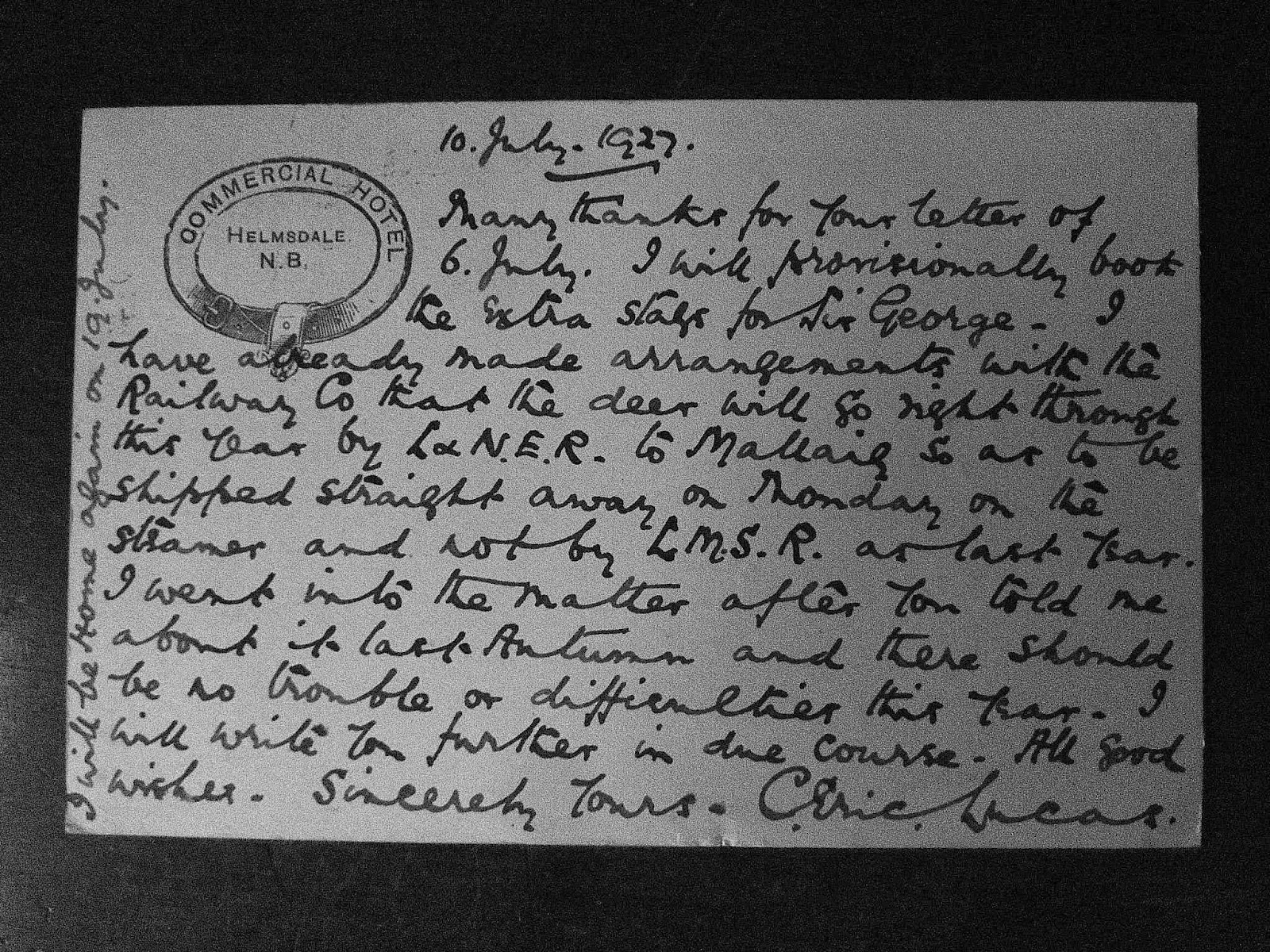
Shipping live creatures to Rhum did not stop at fish eggs, or indeed, as we know, alligators.  Two small postcards from a C. Eric Lucas from consecutive years (1927 and 1928) note that "the stags for Sir George" will be sent direct to Mallaig by the London & North Eastern Railway, not the London Midland and Southern Railway as they were last year; it is hoped that this will avoid the problems experienced with the LMSR (what problems? Did the deer escape?  Were they travelling on the wrong ticket?).  I at first thought this must mean venison, but the second postcard clarifies that live deer are meant: "the best plan will be to mark the six Hinds for Sir George by taking the top off the left Ear. It is as good a distinguishing mark as is possible." Evidently, there was a whole trainload of deer on their way to the Highlands, destined for the hills and perhaps later, the hunter's pot.


Many of the letters are about money, of course; insurance and tax play a major part in the correspondence.  Both George and Monica take a keen interest in the policies and we learn that in the 1920s they kept not only two Trojan cars, but also an Albion and a "Motor Lorry", all of which need insuring.  Meanwhile their solicitors are determined to make their accounts as correct as possible and chase up receipts, valuations and expenditure; we learn that they require proof of how much the estate spends on hens' eggs (£2 15s), but the proof is not forthcoming.  Brebner writes, somewhat tetchily, that their supplier, MacLeod simply refuses to provide receipts: "He is supplying the eggs but no matter how often asked for will never send acknowledgment of payment, treating all business as cash transaction." Instead Brebner is forced to request a copy of his own cheque from the Bank, which is then forwarded to the solicitors.

I learn too of how the new boiler and heating arrangements were ordered and obtained, how kitchen ranges were scrutinised and finally built (in the 1920s, not as early as I expected), and read the original letter of application sent in 1914 by the gamekeeper, Duncan McNaughton, who remained on the island for many years and later became factor after Brebner was sacked. "Dear Sirs, seeing you are advertising for a Gamekeeper Stalker in Sat's Scotsman I apply for same. I am 27 Years old Married, w[ith] family I may say I thoroughly understand Pheasant rearing Grouse and Partridge Driving the breaking and working of mostly all sporting dogs 11 years experience in dogs and the management of a Grouse Moor & of which I had experience in Deer stalking and Driving on the strathgartney [sic] Deer forest and Grouse moor where the killed annualy [sic] 20 stags.  I am strictly sober (and good pipes) You can have my character by writing to Mr John Paterson, Brenachoile Lodge, Trossachs, Callands, and A.S. Maenaghten, Craiginie, Balquhidden, Perth Shire and T.H. Mann Esq., Trulls Hatch, Bothesfield, Sussex.  I am Yours Obediently Duncan McNaughton". 

I've yet to learn what happened next -  during the war, and the flourishing 1920s (although, by all accounts, not as flourishing as the Edwardian years).  We always think of the Bulloughs as Edwardian, but of course they were far more than that; Monica lived through nearly a century herself.  

Meanwhile, we continue to establish ourselves in our own small way; sadly we have no classic cars (nor would the roads let us drive them if we had), but we have our little vegetable plot.  We don't aim to be self-sufficient, not physically - what I want from my time here is to learn to be mentally self-sufficient, but also to learn when and how to need others.  A writer in West Word last month spoke about how in a truly healthy society we would know that we are all dependent on each other, rather than striving for total independence from other people.  People with lots of money can easily become isolated, not part of the social fabric, as well as people who have none, because they can view themselves as not needing anyone or anything, and conversely, not needing to give anything back either.   Sometimes I feel we're so much less advanced than George and Monica - our society here is at such a basic level.  Other times, I feel we're ahead of them in our striving to each contribute what we can.  I'm glad we have the opportunity, as it were, to live alongside each other, past and present.

Hope in our garden - an onion is growing...


7th April - "The season" is nearly upon us - in more ways than one!


Nearly ready to go...but not quite there yet...Garden with our polytunnel in the background


It has been a busy week with things starting to "warm up" ("warm" is maybe not quite the right word yet) for the season to start.  The ferries have "changed over" leading to much confusion - when do I order my veg again? (Thursdays!).  Why have the trains changed but are still not coordinated?  Will we manage to organise ourselves in time for the onslaught of visitors?  First visitors arrive, looking confused and slightly daunted, while days veer dramatically between brilliant sunshine and torrential rain. Everyone is slightly tetchy, things need to be in place but they aren't all yet, we know we need to plan properly but it is daunting outside the context of a "proper job" where so much is often organised for you, or the structures are ready made.  I feel clueless much of the time, but all those years as a PA help!  I have been making plans with Debs for our tea-shop, improvisation being the name of the game so that we don't end up spending too much before we even know how our cafe will work.  We both have a vision of a really enjoyable, homely place to eat and drink really good food, home-made cakes, proper coffee (very important!), local produce, selling Debs' excellent marmalade and hopefully, other islanders' produce, even people's art work, if we can persuade them to display it.  It looks as though Mel's work along with the Visitor Management Group has paid off and the Isle of Rum is anticipating a publicity and tourism boom in spring, so we are trying to up our expectations accordingly, rather than just catering for the odd lost person or two who has got caught in the rain...

The RCA meeting where all this was discussed was very positive, although with the mood on the island last week I was dreading it...arguments seemed destined to happen, but in the end they didn't.  Everyone liked our idea, and maybe some people will even pick up the other days so that we have a tea-shop regularly.  Debs and I have asked SNH if we can use things from the old castle hostel, there is loads of stuff in the old cellar - a formal agreement will, hopefully, be signed.  Then we will have cafetières!  And ramekins! How civilised!  Planning the food orders on the other hand will be complicated - we can't just run to Tesco's or Sainsbury's if we run out, we have to think ahead, at least 2 weeks ahead.  But I feel a tea-shop is somehow my destiny, ever since I got here people have asked me to do it...so the pressure is on!

Seedlings waiting to be transplanted! 
Maybe people's moods are because of that strange time in spring when it feels like everything should happen, but it's not quite there.  So with our seedlings.  Some have come up, some haven't and I am dying to put them all out in the actual garden, but don't yet have the necessary equipment; it is proving near impossible to find anywhere that supplies stuff, at an affordable rate, to the islands.  Even reliable Johnston's in Mallaig only has a few things in (and whenever I ring up they get extremely anxious: "Er, gardening? Don't know if we've got anything this week...") and nowhere seems to sell watering cans.  I've asked on the island for any second-hand stuff, but only Mike has responded, offering us his old wheelbarrow.  I am hoping for a wheelie bin to collect rainwater, but who knows whether it will happen?  So I am getting those well-known spring urges...to visit garden centres!

Well, we are off to Inverness next weekend, so perhaps there we can visit not only garden centres but also cafes, tea-shops, gift shops (any shops are fine to be honest), museums, castles (and do a castle tour ourselves!), exhibitions about the Loch Ness Monster (Mel is giddy already), City Trails and tourist information centres! We will feel like people with lives outside the island...difficult to envisage sometimes.  Now that I nearly have a "proper job" here I understand why for Mel, being here is a 24/7 affair, not one you can put down at the end of the day.  Wherever I go I meet people who start talking about work - because nearly everything here is work - and there is never any let-up from island politics, island grumbling, island ideas and island gossip.  I feel my understanding of Miss Marple's world is deepening day by day...small communities have their own psychology, their own needs and their own developmental patterns, some of which really remind me of how village life used to be in England (or how I imagine it was).  Status anxiety, not about what you own or how big your car is, but about who you are on the island; power is always an issue no matter what kind of community you live in. People need it in different ways - some need to feel that they have their own lives in order, and can keep these private and separate, others need to feel they have some control over others, others need to feel they are influencing a community in some way, good or bad, while others just keep out of it all.  This isn't bad or good, just the way things are, and it is good to come to understand your own way of dealing with it and how you yourself fit in; I haven't quite worked it out yet, I veer between staying out of everything and wanting to be "in on" everything, while knowing that neither will work for me - I need my own niche. 

Geese relaxing, or maybe considering their position

Willow "arches" - a bit bendy
Of course, sometimes we just all relax and it doesn't matter so much, if at all.  It's nice just to sit in the sun, drinking beer or fizzy pop and staring at the sea.  It's wonderful to have time for gardening, cooking, writing and just being quiet.  And it's fun improvising...again like being eight years old, I am becoming a scavenger...as you can't buy a lot of things here from shops, you have to make it up!  I have been scrounging what I can for the tea-shop, and making the most of old tarpaulins, breeze blocks and left over bits of wood for shelves for the polytunnel.  Behind the old walled garden is an abundance of willow, which we've used to make arches for the plants.  Water is more of a problem...there's so much of it on Rum, yet it's so difficult to harness.  I need a big plastic  tub, or even a bath, to keep it in! (And not our own bath, obviously).  I hope the seedlings can bear with us until it is all sorted, and we can look after them properly.


Are you a chiff-chaff or an eagle? You decide...


Life has been looking up.  We have two of our oldest friends, Elaine and Lukas, here to visit, which is magically like being on holiday ourselves, lots of walking in the sunshine, cooking special meals and enjoying each other's company in front of a lovely blazing fire, watching birds and being by the sea.  It makes me realise what a special place Rum can be and how lucky we are to experience this utter quiet and solitude when we need to, how amazing it is to be able to walk for 2 hours and find ourselves at the top of an admittedly quite small mountain, but a mountain nonetheless...

The season has changed, and we all change with it.  Leaving winter behind and moving into spring is an emotional time it seems on the island - people open up, talk more about what they've left behind, what they might need in the future, how they struggle and what things they love here.  Some are contemplating leaving as it has just been too hard, while others make new plans.  Really, we are very like birds - the evenings are light, the days are warm(ish), and now instead of huddling inside, we congregate outdoors chattering away, some of us newly migrated to the island, some of us on our way elsewhere, some hardy settlers who don't go anywhere.

But the main thing is that spring is definitely here, with the first chiff-chaff arriving, daffodils in flower and new life pushing up everywhere, even in our seed boxes where the broccoli is winning the race for first seedlings of our collection!  We sat outside at the back of the castle on the year's first really warm day, planting lots of things to put out in the polytunnel now it is finally up, while thrushes and chickens scrabbled around hoping to get some seed left-overs - no chance, we hurried them (the seeds) all back inside to keep warm as the nights are still extremely cold.  And the nights are clear too - we went out one evening with our telescope and Lukas' special "sky app" which helps you identify the constellations and planets on a little lighted-up screen rather than peering through the night to identify them on our plastic star chart.  We could see Venus, Jupiter and Mars, and Saturn should be visible now too.  The castle was just a dark silhouette in front of the night sky and once you looked away from the torches, you could see nothing at all but stars.  But the castle's emergency lights are always on and it was comforting to return to it and walk through the Great Hall at night, knowing this is our home at least for a time.

Eagle magnets and intrepid explorers..above Coire Dubh
Elaine and Lukas seem to be eagle magnets, and on one walk we saw an eagle three times, once flying lower than we were walking.  That was a really special walk - up to Coire Dubh and then over the "lip" into the actual coire, walking along the little stream and crossing it to join the path up and over the ridge into totally different territory.  Once up the steep hill, we were suddenly on a plateau looking up to the bulk of Hallival on the right and down to an earthy and huge dried-up river-bed to our left, dropping steeply down the mountain.  We wondered what it was, but it seems it's not an ancient geological phenomenon but a newly cut valley caused by the massive amount of rainfall and rocks washing down over the past months.  We felt and looked tiny in this weird landscape, skirting the steep valley and looking down to a lower plateau where the Shearwater Hut is situated...in summer Lesley leads walks up here in the dark (!) to listen out for shearwaters and their babies making troll noises in the night.  Across from us, we could see the Nevis mountain range covered in snow and the distant sight of Eigg seeming small in the big blue sea - a trick of the height we were at made it seem as though Eigg was below us, although we weren't so very high - around 450m.

Top of the world

Looking down - Hallival to the right, Eigg ahead, river valley below
Anyway, we set off down the rocky track and eventually came to the edge, where we stopped for a picnic.  The wind was biting and chill although the sun was warm.  As we set off again, a sea eagle glided silently past below us and incredibly fast.  They seem need no wing-beats at all to get them from one side of the island to another.

I'm an eagle!
It was the first time I had been up so high on Rum and made the island feel very different.  With the sunny weather and the ability to climb (!), it starts to feel as though I could actually be adventurous, roaming off-piste as well as on the not very pathlike paths.  For the first time I felt the call of being high up, not conquering but getting to know the mountains and the tracks.  Some of which are hardly tracks at all but places where deer and goats have trampled down the ground - but following them seems to work, if they can do it, we can!  (Well, that's what we say when we are getting lost, anyway.) We did another walk the next day around Long Loch - the first time I have been really inland, where you have to walk through knee-high grass never knowing where a sudden hole in the ground might open up (walking sticks help to make sure you don't fall in them!).  We saw nothing but huge woolly feral goats, staring at us curiously as we made our cautious way around the loch, following deer tracks we think, and back again to the bridge to cycle home.  

Long Loch - Skye to the right...

...and another eagle
So now it is back to more normal life but with the determination to get to know the island better.  I am otherwise immersed in domesticity - baking what seems like an average of a cake a day, for our visitors and for Mel's Familiarisation Event on Rum (a very nice event where visitors from other tourist attractions came to get to know the island, albeit mainly in the rain), and for birthdays. The Friends of Kinloch Castle were here and "entertained" in the hostel, so we got to know the lovely people who are among the more obsessed fans of our castle (if only there were more of them!).  They have cleared the borders, done lots of cleaning and generally been nice to us, making me realise how much I miss having older people around - our community is generally quite young.  Debs and I are going to take on the tea-shop twice a week, and I am looking forward, somewhat nervously, to providing tea and cake not only for visitors but for us!  Then we have been building the polytunnel and I have been determinedly digging up the ground, even though it is backbreaking work at times.  But the pleasure of being in the walled garden on a sunny afternoon and hearing nothing but birdsong and the occasional Calmac signal as the Loch Nevis comes into the pier, makes up for it all. 

It is strange to be so domestic in such an undomestic setting.  But thinking about it I have realised that I am a lot like most of the women here, even though at times I've felt so different and alien, not a mum, a crofter, a scientist or "islander" (not even a chicken owner!).  But we do have things in common.  We all seem to have this mix of being very "domesticated" (cooking, baking, gardening, "doing crafts", painting etc) with being very adventurous, dreams of practical self-sufficiency being I suppose akin to dreams of being "outside" normal communities and places.  I reckon far more women have this need for real - not just financial - independence and freedom than we let on. Maybe we're not so domesticated or it's the wrong word - maybe we are more trying to make homes in unhomely (unheimlich) places (the German word "unheimlich" literally means "unhomely" but also "spooky" or "weird", so seems quite fitting...). I know for me it recalls nothing more than being about eight years old and "making camps" outside, running about wildly with the gang but always coming back to the hidden places we had made for ourselves.  Perhaps part of us would like to be wild, but part of us likes to feel we can make friends with the wildness instead.  How possible is this?  Still not sure and nor is everyone else, it seems. But if I've learnt nothing else here, it's that things evolve slowly, the important things anyway.  And the other thing I've learnt?  When the sun is out, things seem so much more possible.  


Our Garden - the story so far

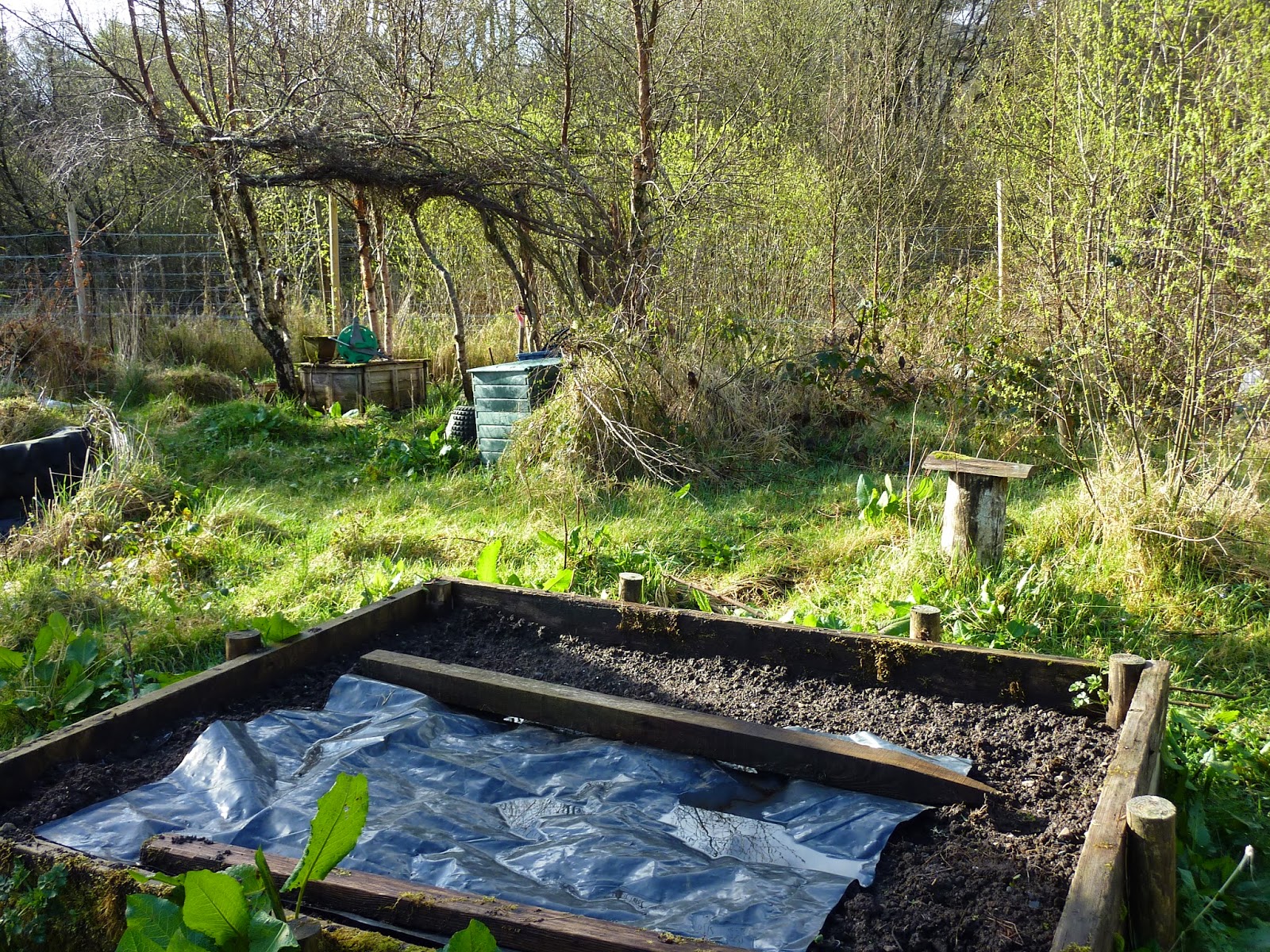
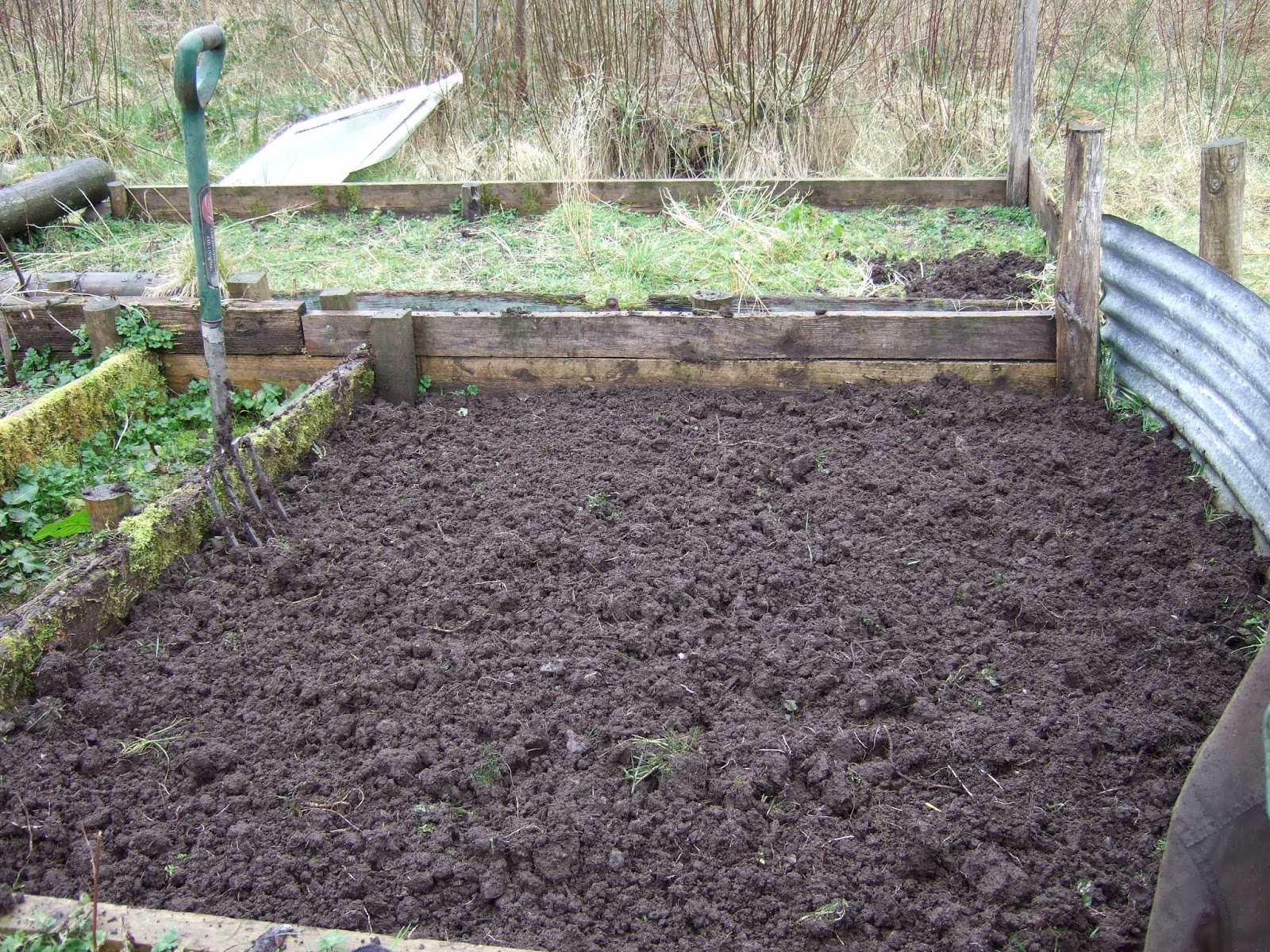
Before (left and back) and After (right). Our three raised beds - thanks Mike!
Nice fork!

Bet Lady Monica never went out looking like this.


Ready to plant!

It's Spring! And so much to tell..

Sign of spring (1)

Well, where to start? So much has happened in my comparatively short absence...fears of boredom as I returned simply can't be justified, as there have been dramas, comings and goings and news at every turn. 
Eigg (left) and Rum from the train

I came back on what seemed to be the first day of Spring, although the day that preceded it was anything but.  Travelling from a hot and sunny Cambridge with blossoming trees, blue skies, cheery tea-shops and flip-flopping students, 500 (?) miles north to a freezing cold Glasgow my heart sank as I arrived at Queen Street and was greeted by sleet, rain and hordes (well dozens) of drunken Scots who had been to see the rugby.  Slept for four hours on the train, and just managed to download "Call the Midwife" (final chance to download anything before island internet kicks in!) before falling into my Premier Inn bed and instant sleep.  One huge breakfast and a beautiful train ride later I was ready to board the ferry...the sun was shining, the sea calm and blue and birds singing away as if winter had never happened.  The sky and sea were so clear, everything was reflected like glass; a far cry from the "keep your eyes shut and pray" journey last time around.  It was lovely to arrive at Rum and see Mel waiting, and walk along the shore road to the accompanying sound of blackbirds, robins and who knows what else (haven't had a chance to check yet!) singing their little hearts out and catching up on each other's news, while I caught up with ours.

Rum...from the boat, 10th March
Since then, my enthusiasm has taken the normal knocks (the internet is soooooooooo slow! the rain is soooooooooooo horrible! etc etc...) but a general sense of excitement is still alive in there, somewhere! So what has been happening? Get on with the gossip, I hear you say...

Tea-shop ructions as Claire gave an ultimatum to the rest of the island about having sole use of the community hall (our only public space)...we said no, and so she has pulled out for good!  Who will provide this vital service now? (See below for some ideas!) The new playground equipment for the children has arrived and is being constructed next to the shop...giant swings and what looks like a survival course climbing frame are first up for use! Debs has started a spinning group - not cycling but actual spinning, some lovely wools are now being produced.  The Ranger has resigned, and a new one is being sought.  Our poor castle has suffered so much from the perpetual rain in February that the ceilings are now buckling ("Just run quickly through the hall and you'll be fine").  

New roof on the hostel (behind the trees) and invisible new roof on the turrets!
The hostel is FIXED, and the roof no longer leaking...Billy has created a brand new one, with an actual slope!  Dave has finally started mending the roads now that the rain has stopped, and several potholes have vanished - it will be strange not to fall in them every night after dark, but apparently some are still irreparable as the rain has just gone too deep.  And it's not only the fabric of the island that the continual rain and darkness of February affected;  February proved just too much for some people and certain set-tos resulting from carelessly worded emails led to an unspecified "police incident", now all peacefully resolved. 

Sign of spring (2) - turkeys displaying
But although today it's raining again, we know that Spring is here.  It's not only the daffodils finally pushing through to the light, or the birdsong, or the turkeys attempting to get it on up at the croft. It's something about the fact that it's now light until 7 pm rather than 3 pm, the way we can walk around the village without wearing three hats and five scarves, a birthday celebration that takes place in the light not in the dark.  A sense of new beginnings.  Which everyone needs in spring, but we need it perhaps just that little bit more than those sun-spoiled Cambridge types. Being away has given me a bit more perspective and it's so clear from people's stories that winter is just really, really tough here.  We're not kind enough to ourselves.  We didn't create a social space for ourselves over winter, didn't continue the Sunday tea-shops (or any tea-shop), didn't think about how we might deal practically with the undoubted fact that the word isolation comes from the Latin word for island.  How can we make it better?

Everyone has their own story.  Gav and Laura and their new baby are living in a friend's room, the weather has been too awful for them to finish their croft, and they wonder how long their resilience will hold out, much as they want their new life here to work.  Debs is new to the island like me and, also like me, is here because of her partner's job, spending much of the time on her own at home; self-sufficiency and "being creative" is all very well, but...One couple's marriage has (we hope only temporarily) broken down.  Other people struggle with accommodation issues.  Yet on the other hand, this can be such a wonderful place to live.  We talked yesterday (during an all-day Six Nations TV marathon - yeah!) about how we could stop being so isolated, have more fun, enjoy things more.  

I came back full of positive thoughts, ideas to make things work better, things I can do myself to help out.  What stops me?  Fear that nothing will come back from others - this is a real issue, so often the impulses I have had here and the suggestions I've made have met with no response whatsoever - more daunting perhaps than an outright "No." Or perhaps I've set the bar too high. This isn't like at work, where you can ask people for things and they are bound to help you if they can.  No-one here has to do anything, if they don't want, and many people are busy enough already.

However, it's amazing what just talking to people can do.  Chatting to Debs in her sunny kitchen over lovely coffee (the first time I've been to someone's house for coffee!) we hatched a plan to take on the tea-shop for two days a week - daunting but exciting.  And also, what is even more daunting, to try to set up a coffee morning (or afternoon) one day a week.  A drop-in?  A book group? Or just a place to sit and drink excellent coffee (very much lacking on Rum!)?  I now have to work up the courage to actually ask people!  It sounds so odd, but it can feel as though the onus is entirely on you not only to ask a question, but to provide the answer yourself too.  

There are many things that need doing besides this.  The archiving.  The tea-shopping. The Rum guide-book which I am applying to write.  Keeping the flat clean (now it's Spring we can see all the dust!).   Ordering food.  Keeping an eye on those dodgy ceilings.  Plus, we are now starting a garden; this is a long-held ambition, and the outgoing Ranger has very kindly bequeathed us his raised beds in the back of the walled garden...we have started digging them over, but I can see there's going to be a lot more work involved...

But I feel sure that having some kind of island get-together, a daytime chance to sit and just chat, is the most important. Probably because it's the most important for me.  Hell, if no-one comes along I'll just eat all of those cakes myself, and what will I have lost?  Nothing really.  But the fear of failure really can be more than just worry; it can stop you doing absolutely everything.  So we have to overcome it.  Or nothing will ever change!

Sign of spring (3): smiling!


So what is Burns Night anyway?

By popular demand...here is how we celebrated Burns Night on 25th January:

http://www.flickr.com/photos/nicgee/sets/72157640189839624/

This is one of the most popular events in the Rum calendar...it marks the end of the January blues and reminds us of what a lovely community this can be.  Nearly everyone was there including baby Maggie, making her first public appearance with Gav and Laura since they came back to the island on the 23rd.  It was so special to have a new baby there, as well as all the older babies, and all of us!

Burns Night celebrates the Scots poet Rabbie Burns, who loved Scotland and its people.  The evening has a tradition just as important as Christmas for Scots, involving:

1. The Procession of the Haggis (The haggis is ceremonially brought into the hall accompanied by piping; on this occasion courtesy of Reserve Mike (guitar), Ranger Mike (guitar), Sean (drums), and Ross (also guitar); no pipes, but plenty of clapping!)

2.  The Address to the Haggis.  This is the traditional recital of the Burns poem that begins:

Fair fa' your honest, sonsie face,
Great chieftain o the puddin'-race!
Aboon them a' ye tak your place,
Painch, tripe, or thairm:
Weel are ye worthy o' a grace
As lang's my arm.


(The full poem and a translation for us Sassenachs can be found at http://www.robertburns.org.uk/Assets/Poems_Songs/toahaggis.htm)

The gist of the poem is: Scotland's poor people and Scotland itself need proper fare, not just watery soup.  And although it stands for lots of other things besides food, being on a cold island in winter you certainly appreciate a real Rum haggis: made of our own venision by Marcel.

Dave recited the poem dressed in his full Scots gear - in fact several of the men sported their kilts, looking dashing and not in the least bit girly.

3.  Toasting the Haggis.  While the address was going on, Ady was going round filling up our glasses with whisky, so that we could toast the haggis in the proper manner. An enthusiastic moment!

4.  Eating the Haggis.  Lesley and Abby, Dave and Sylvia had prepared not only THE haggis (which was huge, made of venison by Marcel, and worthy of Burns himself) but also neeps and tatties plus a vegetarian option. I made pudding (Cranachan).  This part of the evening went on for quite a while.

5.  The Addresses. Traditionally more Burns (and other) poems are recited after the meal, and this time Nic and Ady did us proud with their own "Address to the Lassies" and "The Lassies' Response", describing how Rum would be nothing without either the lassies who "run it" (thank you Ady!) or the laddies who make it all happen (thank you Nic!). We all need each other...

This was followed by Mr Rhys' recital of "To a Mouse", then a poem by Lesley and some jokes and tales...until it was time to start the singing and dancing by the singing of "Auld Lang Syne".  We gathered together and linked arms for a rather patchy, but heartfelt tradition.  Steve had brought an old song-book belonging to his father that explained both words and music of many a Highland song, and I understood for the first time the meaning of the poem.

6.  Music.  The band, now well-lubricated with wine, whisky and song set up a medley of new and old music...although by around 11 pm the singing was getting decidedly dodgy.  However, by that point no-one cared.  Mel and I tripped a measure and Nic and Debs tripped several!  The ceilidh did not develop very far, but the music was grand.  

It was a wonderful night and made me realise how important it is that we show our strength as a community and do things that bring us together.  It's so easy to stay isolated in our little homes, especially when there's a gale blowing outside and it's sleeting or snowing.  But all of us need each other, and my resolution when I am back is to try harder to make those connections with others - especially when it's reaching across the Scots-English divide.  Although, maybe I should invite people round for whisky rather than coffee...

From EastEnders to Emmerdale...and everywhere in between!

The other end of the country...calm after the storm
I can't take the credit for this post title...it belongs to a young lad working in the Orange call centre whom I spoke with today.  He couldn't help me with my phone, but when I gave him "The first line of your address, please madam?" we kind of got off the subject of phones and started talking about Rum. When I told him I'd lived in London before moving to a tiny island, and would like to write a book about it, he said, "Aw! So, like, from EastEnders to Emmerdale kinda thing, yeah?"

So, if in the future you should notice a modest volume with just that title peeping out in the travel section of Foyles or Waterstones, or see it at Number 1 in the bestseller charts, you'll know who thought of it first (if it makes number 1 then I may have his lawyer on the phone to ask for a cut of the royalties...I'll have to help him move out of call centres and into publishing...)

Anyway, I thought I'd try it out here first although actually it's a bit inaccurate.  It should really be "From Emmerdale to Eastenders and back again" because over the past month I feel as though we've travelled the length and breadth of the country.  From our tiny isle in the snowy north of Scotland, to the crashing forty foot waves of Portland Bill, and everywhere in between. Looking back over the past few weeks, it's hard to put it into a narrative - what I see is more a series of events, small and large, marking a long transition from a dark January to hopefully, a kinder and brighter spring.

I felt the first ray of sunshine before leaving Rum, when we finally saw otters! It was a freezing January day, most of us still hung over from Burns Night (which I WILL post on the blog...), hailstorms threatening from the north-west.  We were hit by the hail just as we meant to go out, but after we'd cowered behind the post van for 10 minutes in our waterproofs it cleared up and we decided to go for our planned walk after all.  "Just to the otter hide, though," we said. But somehow we kept going.  We clambered clumsily along the beach with its red, awkward stones slippery and niggly underfoot, making our way onto the even more slippery and awkward path that leads up away from the beach, through undergrowth, trees, streams and bogs eventually to what feels like the far edge of the island, land and rocks gradually thinning out until only the mossy ruins of the blackhouses and the irregular, spiky trees remain against the sea and the snowy mountains beyond.  Of course we got lost. But we didn't care, as by then we'd already seen the otters!

We had climbed up a little way to the first "ledge" of the cliff where you can stand and catch your breath, rearrange your clothing etc, which is usually already too hot after the first ten minutes or so, and as we were rearranging (and trying not to fall into the puddles) we heard a weird squeaky, chattering sound that seemed to come from out at sea. It wasn't like any bird we knew. Mel grabbed her binoculars and looked out to sea and "Otters!" Swimming, but not just swimming, curvetting through the waves like dolphins with rounded backs and diving snouts, and much faster than you would imagine - two of them on parallel paths, chatting to each other as they went. Soon they were round the corner and out of sight but we had seen them, for the first time in either of our lives. But more was to come.  After we had reached the peninsula and found a freezing cold, but relatively sheltered spot to eat our picnic, I was scanning the waves when - there it was, another otter popped up, on its own this time.  We watched breathlessly (and even let our tea get cold) while it came ashore and lay wriggling in the sunshine to dry itself, apparently not worried by our company.

That was a lovely day, and it meant so much to have seen these most elusive of creatures before I left, reminding me just how amazing the island can be.  Why does it lift your heart to see creatures in the wild?  Two days later I left for the mainland but this time on a beautifully clear day, with no high winds or storms, just a lucid sea and sky with the Cuillins remote and cold-looking as a lunar landscape, no hint of habitation or vegetation anywhere on them, bare and forbidding as a desert.  All the way I was sad, although the ferry journey was livened up somewhat by the awesome S., who told me all about her complicated family and the funeral she would be going to on the mainland. She drank two half-bottles of wine on the way over ("Well, we're on holiday now"), knew everyone on the boat and didn't appear even tiddly by the end of the journey...I left her greeting her second ex-husband whom she married too young and to please her mum, her third husband and true love having stayed at home to mind the kids.

The journey to Fort William on the "Harry Potter Train" was incredibly beautiful, that warm sunset light shining across from behind Rum on to the mountains to my left and making them glow orange and red.  I'd never seen it like that before.  Still less had I expected the journey down to Glasgow the next day to be so amazing, traversing the Highlands with constant glimpses of lakes, waterfalls and snow-laden moors stretching for miles with hardly anything else in sight but deer and occasional lorries.  The summit at Corrour was a pure white landscape with dark, bubbling rivers running through it...a featureless landscape one would say if it weren't for the stags starting up amazed at our audacity to drive through their bit of territory.

From Glasgow it was a mildly chaotic journey, with lines down at Penrith meaning I had to get to Edinburgh instead before I could get down to London.  But that was only the first and most minor hint at the craziness the weather has caused in England...Rum has got off lightly in comparison.  There were floods everywhere we travelled past and even in London the parks were sodden with the constant rain.  From London we went on to "As Seen on TV" Weymouth, seizing the one day without rain to travel out to Chesil Beach and Portland Bill.  Chesil Beach was impossible to look at....it went on and on, disappearing at the horizon into clouds of spray and a vast grey sky, with the road and cars that run alongside and below it seeming unreal in comparison, like two films running concurrently in different languages and on a different scale. I couldn't get both into my head at the same time, even now it is quite hard to remember, let alone describe. But Portland Bill was even stranger...we stood for ages staring at the awesomely huge waves, how they come in from far off and appear incapable of breaking, until suddenly, at the last minute, they do. Impossible to imagine those waves even bigger, sweeping over the lighthouse, but that is what has been happening.  

There were no trains to Exeter of course and none on to Cornwall, so we travelled by the "Jurassic Coaster" double decker bus through Dorset and Devon to Exeter, descending steep and crooked roads into towns where normally the sea is sedate and pretty, but now was a huge uncontrollable creature dashing itself against the harbour defences, walls and beaches, waves driving in at maybe 30 miles per hour (?) to crash against the rocks.  While listening to the elderly ladies around us quoting the Daily Mail approvingly ("That Nigel Farage, he does have some good ideas"), we veered between worry and excitement. Would the bus make it down the hill?  Would it slip off the road and into the sea?  Somehow we couldn't be scared..we felt more awe at the sights around us. It was an exciting journey and we talked about what we could do together on Rum and the good things that the future might hold for us there. And, in a semblance of our former life, we then got to drive a car...all the way down the near-empty A30 to Cornwall, where we spent a week in a strange state of limbo, not able to do most of the walks or trips we would normally do as so many places were "out of bounds" due to the weather.  

So now I've been travelling up, down and around this flooded country for nearly a month, and am still not home. Our travels have led us from Scotland to London, Weymouth, Dorset, Cornwall, Kent...everywhere there are wringing wet fields, oceans of water covering farmland and footpaths, undercut cliffs, fallen trees and enormous waves...and even now the waves have settled down a little bit, the sea still holds an undercurrent of threatening energy, you can see it still in the too-high tides, the curling and foaming pools in the harbours and the way in which the normally tranquil English Channel continues to slap at the land as if to say, "Don't forget about me!"  As if we could.  Travelling back from Exeter to London on a very slow train indeed, we watched how the rivers continue to rise, seeing them churn and overflow banks that are no longer visible.  Passengers on the tiny packed train were not stressed out, not even "philosophical"; there was nothing more to say really, so it was quiet, with heads turning in unison whenever we passed a particularly flooded area, such as Romsey where half the town stood half under water.  Buzzards sat in the wet fields and waited for...something, we speculate for lost fish!

We have been lucky enough not to be directly affected, so I can't help feeling excited rather than worried or upset, although Mel's aunt, who comes from Somerset, was very sad after visiting her parents there: "It's like looking out to sea," she said. Perhaps it is quite sobering, after all.  I've noticed a kind of rootless feeling, like the trees you see lying devastated by the water...and through it an increasing sense of how peculiar our civilisation is.  On Rum there has been non-stop rain (so I hear), but no floods of course, as all the rivers run straight down the mountains to the sea and out!  There are no flood plains, no over-crowding with new housing developments, no neglected flood defences or concreted-over gardens.  There is a place for the rain to go even if humans find it slightly more difficult to identify a home. 

I still have my home, so I am very very lucky.  But just like everyone else I need to deal with the question of how to live with, rather than in conflict with nature.  Some people who are concerned about climate change would like everyone to live like we do on Rum.  That might be ecologically better but doesn't solve the problem of how humans and nature exist together.  We build cities for a reason, the joys of civilisation are just as real as the joys of the natural world, and when it's cold, dark and dreary outside then the joys of a DVD are not to be underestimated!  The raw unmediated experience of "nature" in its least amenable form is something more than a "survival challenge" a la Bear Grylls or an RSPB "Date with Nature".  Yeah...it's not so much a date with nature as full-on, non-negotiable Getting-married-to-nature-and-having-its-children, I-wish-I'd-sorted-out-that-prenup-earlier emotional rollercoaster.  It's not a survival challenge in the sense that you go there, gleefully relish whatever it throws at you for six weeks and then leave to tell your tale to idealistic, if less hardy, TV audiences. (Though I wouldn't say no!)  It's a survival challenge in that it challenges everything you think you know about normal life, your identity, your relationships with others, your concept of what "society" is for, and your ability to influence where you are. I wonder if this is how other people feel who have been isolated in tiny communities with seas of water surrounding them...

Now down in Kent, I've been talking to a Scottish doctor who comes from "up there", but is married to a Whitstable lass.  I wasn't expecting anyone to understand what on earth I was talking about but to my amazement it turns out he is from Lochaber.  "I took the wife up there for a year...she couldn't cope.  We were in the Cairngorms, not on an island so the social life was fine...it was the weather that broke her, the darkness, the cold..." He doesn't need to go on.  I nod, understandingly.  I ask him if it's common to have an anxiety reaction to living in such an isolated community.  He replies vigorously, "It is!  Of course it is! The west coast of Scotland is notorious for it..." I feel a little bit better - and also fascinated.  My anthropological interest is bearing fruit!  I ask him why that is.  He says, and I find this really interesting, that it's to do with a culture clash. People from down south, English people, city Scots looking for a lifestyle change, looking to live the dream, turn up in places where "the dream" is everyday reality and they don't know how to fit in.  Some places they start to define the culture, as on Skye, which, catering for mass tourism, has also attracted so many new people to live there that it no longer feels like a Scottish island (not to me anyway), beautiful as it is. But in other places like on Rum the communities are so small that the clash remains obvious and tricky to negotiate.

This isn't a complaint. (No, honestly!) I'm trying and trying to understand what it means to live somewhere so different.  Do you have to change your own needs?  Do you change the island, so that it meets your needs?  What is the compromise?  Or do you just adapt and let Rum change you, let the island itself guide what you need to become? What does it say about me, and Rum, that I can write there more than anywhere I've ever lived before, yet can't go for more than a few weeks without becoming massively anxious?  Can living in such a crazy state of closeness to nature actually provoke crises in people, in both a good and a bad sense...can it in fact have even a quasi-medical effect, a kind of physical intervention that changes you for either good or bad? 

I know that the answer for me is yes, and it's only just begun.  I think that just the fact of living somewhere so silent, so hugely un-human and with proper air, water and space, makes us breathe, think and feel differently.  It shows you sides of yourself you never knew you had.  It forces you to behave in ways you might never have behaved otherwise.  It shows you what matters to you, what you can do without and what you really cherish.  It can make you feel.  As we went through Britain and saw the flooding and slept through weeks of gales and storms we also saw the fascination of nature.  We saw how people crowded to the sea to watch the crazy waves, sometimes at risk to their own lives.  We saw how despite the sadness and horribleness of losing your home to a flood people were awed by the rivers and their power. We share that power - we are natural too, and we see our emotions, passions and physical needs mirrored in the "other" nature around us. What would it mean if we really took that seriously? 

What I cherish. Close to nature...
and even closer.
And how have I got from floods, to Rum?

Mel's uncle is a marine biologist and he recently attended a massive climate change conference where he and his colleagues came to the consensus that basically, the world has 20 years before "this" - floods, hurricanes, states of emergency - starts to look normal.  There is a massive challenge in that, one that I don't think people will know how to meet.  I certainly have no idea.  But looking at the challenges people are facing on the mainland right now, I feel privileged to be somewhere where I can experience a "different" civilisation without it being a "ruined" civilisation.  Rum is not at the end but at the beginning of a transformation.  It feels new, even though the island of course is old.  We are putting a community right in the middle of something totally un-communal, and I want to know how it works out.   

As seen in Herne Bay today.  Maybe that should read "Do fall in love it hurts..."